Hydrogen Technology
Water Quality and Hydrogen Generation: What Changes
Why hard tap water and mineral water work against a PEM cell, what that does to the electrode, and what this range does not publish about feed water.
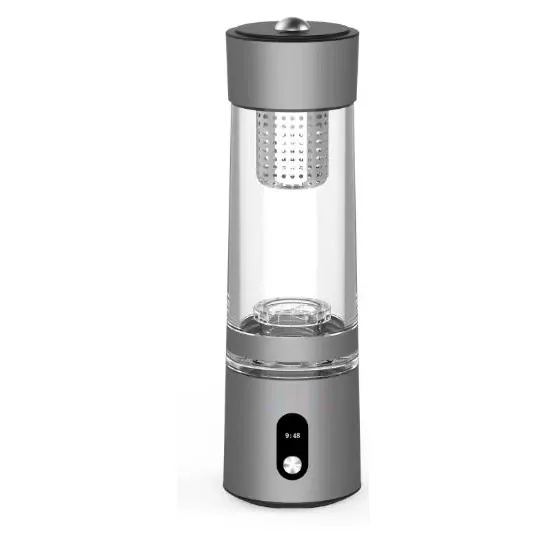
Two people own the same hydrogen water bottle and get different numbers from it. The difference is usually not the bottle. It is what came out of the tap.
QUICK ANSWER
A PEM electrolysis cell is designed around high-purity feed water. Minerals and hardness do not make the water more hydrogen-rich; they leave residue on the electrode and shorten its working life. Use the softest, cleanest water available to you, and ask the seller for the model's own stated water requirement before you settle into a habit.
01 What the Science Says About Feed Water
A PEM cell uses a solid polymer membrane as the electrolyte instead of a liquid bath. That design is what makes a bottle-sized generator possible. It is also why the literature on PEM water electrolysis describes high-purity feed water as a requirement rather than a preference, citing membrane degradation and catalyst poisoning as the consequences of contamination.
Catalyst poisoning is what matters for a consumer. The electrode carries a coating that does the work. Minerals in the water can deposit on that coating and block its active sites, and that loss is not something a rinse restores.
02 Three Kinds of Water, Three Different Problems
Hard tap water carries calcium and magnesium. In an electrolysis cell those are the minerals that form scale, which is a physical deposit you can partly clean off. Catalyst poisoning is different: it is a chemical change at the electrode's active sites that a rinse does not reverse. Both shorten the electrode's working life, but through different routes.
Mineral water is sold as a premium product, which makes it feel like the better choice. It is the opposite of what a PEM cell wants, because its whole selling point is the dissolved mineral content that an electrolysis cell has to tolerate.
Purified water, whether from reverse osmosis or distillation, is the direction the literature points to. Where a household already has a reverse osmosis unit, that output is the closest thing to a feed-water specification most people will have access to.
03 The Reading That Does Not Move
A hydrogen concentration figure is a measurement of dissolved hydrogen after a stated cycle. It is not a measurement of how much hydrogen the water now contains beyond what the cycle produced. Two bottles fed from different sources and run for ten minutes will both produce hydrogen-rich water, and the one fed harder water will not somehow produce more of it.
So when a listing quotes a big PPB figure with no water condition attached, that figure was almost certainly produced under favourable conditions. It is not false. It just does not tell you what you will get from your own kitchen.
04 What This Range Does and Does Not Publish
On the specification pages for this range, the stated values are capacity, concentration at a stated cycle length, hydrogen purity, body material, battery, charging port, dimensions and colour. A water-quality specification, in the sense of an approved source, a hardness limit or a dissolved solids figure, is not among them.
That is worth knowing before you buy rather than after. Ask the seller directly what water the model is specified for. We can give you the model-specific answer on request, and that is the kind of detail worth having in writing before you commit.
05 Habits That Cost Nothing
Use one water source consistently, so that if the electrode starts to show a film you know what changed. Do not leave a full bottle standing for days, because standing water concentrates whatever was dissolved in it onto the surfaces. And run the backwash cycle where the model has one, since that is the mechanism the manufacturer put there for exactly this.
If your water is hard and you have no way to soften it, the practical answer is to clean more often and to ask the seller whether the model tolerates your source. That is a better use of a question than guessing.
Next Step
Tell us what water you intend to use, whether that is tap, filtered or bottled, and we will tell you what the specification sheet for a given model says about it. If you are choosing between models for a household with hard water, send us that detail with the model numbers and we will answer in writing.
Guangzhou Baijiale Import and Export Co., Ltd has built hydrogen products since 2019, covering research, development, production, sale and service of hydrogen inhalers, hydrogen water bottles and cups, and PEM hydrogen generator membranes.