Hydrogen Technology
Do Hydrogen Water Bottles Do Anything? What Research Shows
Two small human studies, one systematic review, and the limits of each: what hydrogen-rich water research actually supports before you buy a bottle.
Anyone shopping for a hydrogen water bottle hits the same wall. The listing says antioxidant, the reviews say life-changing, and the price says this must do something. What the published research says is narrower than either.
QUICK ANSWER
There is human research on hydrogen-rich water, and it is small: pilot studies of ten to twenty people, one open-label and one double-blind. Reviews describe the early results as encouraging and call for larger trials. No major regulator has approved a hydrogen water bottle as a treatment or cure for any disease, so the honest reason to buy one is that you want the product, not that it is proven to change your health.
01 The Two Human Studies That Get Cited
In 2010, Nakao and colleagues ran an eight-week open-label pilot with 20 people who showed signs suggesting metabolic syndrome might develop. Participants drank 1.5 to 2 litres of hydrogen-rich water a day at a stated concentration of 0.55 to 0.65 mM. Superoxide dismutase rose 39 percent and urinary TBARS fell 43 percent. By week four, HDL cholesterol was up 8 percent and the total cholesterol to HDL ratio down 13 percent. Fasting glucose did not move.
Open-label means everyone knew they were drinking the hydrogen water. There was no placebo group. A result like that is a signal worth following up on, not a demonstration, and the authors called it a pilot study themselves.
The second is more carefully designed and much smaller. In 2012, Aoki and colleagues ran a double-blind crossover pilot with ten male soccer players, who cycled for 30 minutes at 75 percent of VO2max and then did 100 maximal knee extensions. Hydrogen water prevented the rise in blood lactate that appeared with placebo, and avoided an early drop in peak torque. Oxidative injury markers and creatine kinase did not differ between the groups. Ten athletes, one session each, two outcomes that moved and two that did not.
02 The Review That Asked the Blunt Question
If you want the widest single view, start with the 2024 systematic review in the International Journal of Molecular Sciences, whose title asks whether hydrogen water is extra healthy or a hoax. Two blinded reviewers screened the literature and included 25 articles. Their conclusion is that early trial results are encouraging, that mechanisms remain incompletely explained, and that larger and more rigorous studies are needed.
That is the honest state of the field, and it is worth reading twice. Encouraging is not the same as established, and a review that frames its own subject as a possible hoax is not a marketing document.
03 Where the Evidence Stops
Three limits matter. The sample sizes are tiny, which means a real effect and a statistical accident look identical from the outside. The strongest design here tested athletes in a single lab session, not someone drinking two glasses a day for a year. And the outcomes measured are biochemical markers, not anything a buyer would notice in daily life.
None of that makes the research worthless. It means the correct sentence is that hydrogen-rich water has shown some early biochemical effects in small studies, and not that it will do something specific for you.
04 How to Read a Claim on a Listing
Claim language is where this category separates careful sellers from careless ones. A listing that names a disease, or says the bottle treats, prevents, cures or repairs anything, has stepped past what the research supports and, in most markets, past what the law allows for a consumer product. A listing that states concentration and cycle time, and cites a paper by name, is telling you what it can defend.
Be equally wary of a single big number with no conditions attached. Any electrolysis bottle reaches a higher concentration if you let it run longer, so the figure means nothing until the minutes are stated alongside it. That is a specification question, and it has a definite answer.
05 What Actually Varies Between Bottles
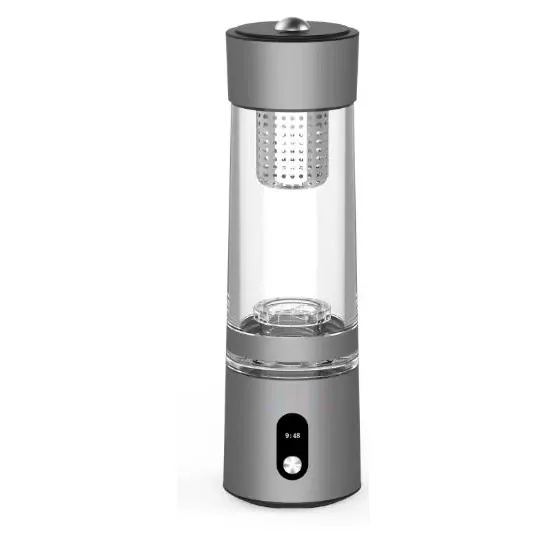
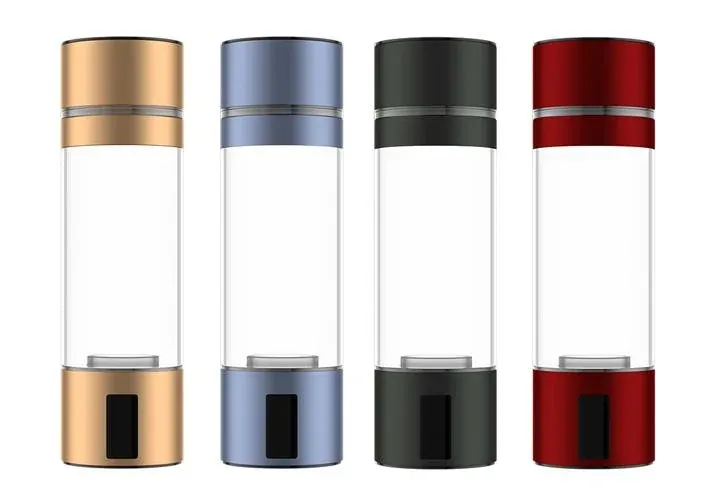
Since the health side is unsettled, the differences you can verify are the ones worth deciding on. Concentration and the cycle time that produces it come first. Capacity decides whether you are making one glass or filling a jug. Battery capacity determines how many cycles you get between charges, and electrode material determines what the water passes over.
In this range, the 400 ml BJL-HW07 is rated 4000 ppb at five minutes and 8000 at ten, with a 4000 mAh battery. The 750 ml BJL-HW08 is rated 2000 to 3000 ppb at ten minutes and 3000 to 4000 at twenty, with a 316 stainless steel liner. The 235 ml BJL-HW01 is rated 3000 ppb at five minutes and 5000 at ten. Those figures are checkable, and they differ in ways you will notice daily.
Next Step
If you tell us how much water you drink in a sitting and how often you would use it, we will recommend the model whose capacity and cycle time fit that habit. If you want the specification sheet for a particular model before deciding, send us the model number and we will send it.
Guangzhou Baijiale Import and Export Co., Ltd has built hydrogen products since 2019, covering research, development, production, sale and service of hydrogen inhalers, hydrogen water bottles and cups, and PEM hydrogen generator membranes.