Sep 14, 2026Hydrogen Technology
Hydrogen Water Bottle Care: Daily Use and Maintenance
Working modes, water temperature range, capacity and battery: what the spec sheet says about daily care.
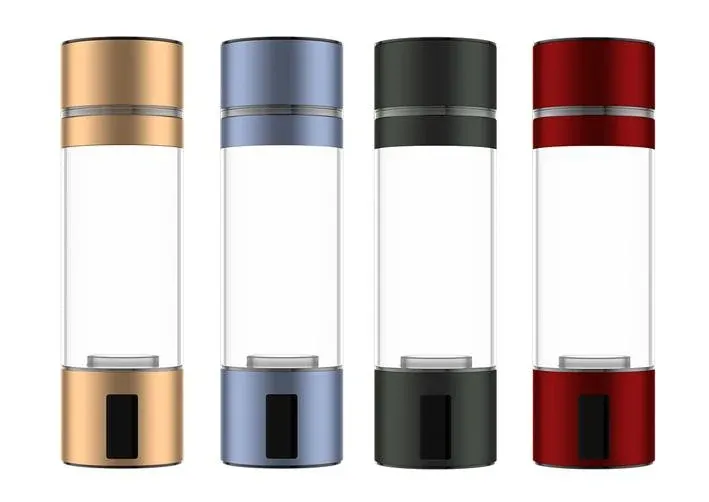
A hydrogen water cup is specified with working modes, a water temperature range and a battery capacity, and those three figures tell you most of what you need to know about daily use. This guide keeps to what the specification sheets actually state, so you can brief your customers or your support team accurately.
QUICK ANSWER
Use the cup within its specified working mode and its 0-60 C water temperature range, match capacity and battery to how the product will be used, and confirm any maintenance question against the model's specification sheet.
01 Respect the Working Mode
Each model is specified with a working mode expressed in minutes, and that cycle is the basis for normal use. The ZHDY-Q15 and ZHDY-Q16 series are specified at 5 / 10 minutes, the ZHDY-Q17 at 6 / 12 minutes, and the ZHDY-W10-2 pitcher at 10 / 20 minutes.
The longer cycle on the W10 pitcher follows from the larger volume it processes: the W10-2 is a 2000 ml pitcher, against 230 ml on the Q15, 300 ml on the Q16 and 400 ml on the Q17. Bigger volume, longer cycle, larger battery. Confirm the working mode for the exact model or variant you order, because it can differ between variants of the same family.
02 Keep Water Within the Stated Temperature Range
The cup range is specified for water at 0-60 C. That range is the practical guide for what to put in the product, and it is worth repeating to customers in plain language rather than leaving them to infer it from a specification sheet.
Staying inside the specified range is the simplest habit to build around a hydrogen water cup, and it is the one most likely to be overlooked when a product is used daily.
03 Understand Capacities and Batteries Before You Advise
The capacity and battery figures differ across the range for a reason. The Q15 series is 230 ml on a 2200 mAh battery, the Q16 is 300 ml at 2200 mAh, and the Q17 is 400 ml at 4000 mAh. The W10-3 is 1000 ml at 4000 mAh, and the W10-2 is 2000 ml at 9000 mAh.
When a customer asks how many cycles a charge covers, the honest answer is that it follows from the working mode and the capacity, and it should be confirmed against the model's specification rather than generalised across the range.
04 Know Which Features Change the Advice
Several models carry a function that changes how you explain the product. The Q16 is specified with a touch screen, a bilingual voice prompt and a backwash function. The Q17 carries an inhalation function in the cap and is specified at 2000-3000 PPB. The W10-2 carries a low-frequency function.
Across the range the products are specified with SPE/PEM hydrogen-oxygen separation, no residual chlorine or ozone, and no heavy metals above the standard. The Q15 and Q16 are specified at 4000-5000 PPB and the W10 models at about 2000 PPB. Materials are stated as alumina and PC on the Q15 and Q16, with the Q17 offering borosilicate glass as an option and the W10 models using food-grade PC.
05 Handle Maintenance Questions with the Spec Sheet
The most useful policy for a support team is to answer from the model's specification sheet rather than from general habit. Working mode, water temperature, capacity, battery and feature set are all documented per model, and those are the figures that resolve most customer questions.
Where a question is not answered by the specification sheet, confirm it with the manufacturer before advising the customer, rather than issuing guidance the product documentation does not support.
Next Step
If you are supplying this range and want the specification sheet for a specific model to brief your team, send us the model codes through the contact form and we will follow up.
Guangzhou Baijiale Import and Export Co., Ltd manufactures and exports hydrogen water bottles, cups and pitchers alongside its hydrogen inhalation machine range.